
How does the shaping of a new public world affect the material well-being—the quality of life—of Kerala’s people?”
- Robin Jeffrey in Politics, Women and Well-Being (1992)
How does the shaping of a new public world affect the material well-being—the quality of life—of Kerala’s people?”
- Robin Jeffrey in Politics, Women and Well-Being (1992)
Travelling Through Kerala with a Camera in 1983: Photographs by Author and Kerala Scholar Robin Jeffrey
This was the question that guided Professor Robin Jeffrey in his travels to Kerala in the 1970s and 80s. In 1983, Professor Jeffrey and his wife Lesley, with their newly purchased Nikon camera and their patient driver Gopi, spent ten days travelling from Kanyakumari to Kochi and photographing a place under rapid transformation.
The Gulf boom was already a decade old. Remittances were flowing into Kerala, old things were being discarded, and historic buildings were coming down. Their journey led them to a dozen houses where they met generous hosts and encountered fascinating objects. The result was an abundance of black-and-white photographs, later donated to the Kerala Museum, preserving a Kerala undergoing change during the 1980s.
Jeffrey’s photographs, when viewed together, is an archive of Kerala in a state of flux. They depict a place that is strange yet familiar. Through this exhibition, we try to view photographs in a function beyond memory—as historical archives that help us understand a society in constant evolution, what it kept and what it abandoned.
A Shop Full of Stories
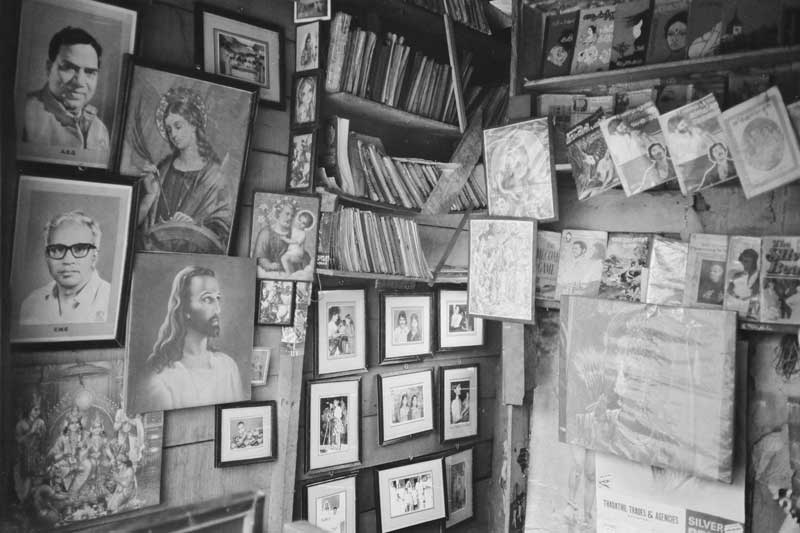
Taken on 29 November 1983 in Kottayam, this photograph captures the interior of a shop whose walls are covered with images and printed materials. Kottayam—also known as “Akshara Nagari,” meaning the “city of letters” for its contribution to print media and literature—has long been the centre of Kerala’s publishing world. By the 1980s, Malayalam-language newspapers and magazines had made Kerala into a remarkably news-hungry population where print media was a part of daily life. Jeffrey’s writing argues that this was inseparable from the state’s attitude toward women and literacy. The relative freedom women enjoyed and their eagerness for education had built the base on which a reading culture flourished. This photograph is a slice of that culture.
Jeffrey on Literacy
A single image dramatized Kerala’s literacy for me. I was on a bus lurching northwards out of Ernakulam early on a monsoon morning in July 1968. Heavy rain bubbled into the red laterite soil and surged down the sides of the road like strong tea. The canvas window-curtains were let down to keep out the rain, and the inside of the bus steamed. At the first stop, I lifted the curtain to let in some air. A few metres away, an old woman dressed in white sat dry and comfortable on the narrow verandah of her house. What startled me was what she was doing. She peered intently through thick spectacles, and propped expertly against her crossed leg was her morning newspaper.
I had been teaching in a high school in Punjab in north India for about a year at that time, and among 150 boys who were my pupils, only one wore spectacles. Newspaper-reading, even among men, was not something I commonly saw, and I could not remember having seen an old woman reading a newspaper. This was the beginning of my perplexity about what made Kerala literate. Though I could not have known it then, female literacy in Kerala in 1971 proved to be 54 percent; in Punjab, only 26 percent.
From Robin Jeffrey, Governments and Culture: How Women Made Kerala Literate (1987), p. 447
A Revolution Memorialized
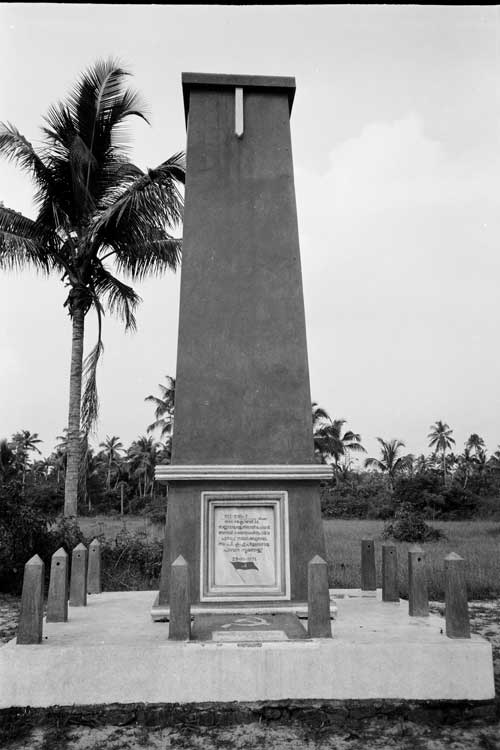
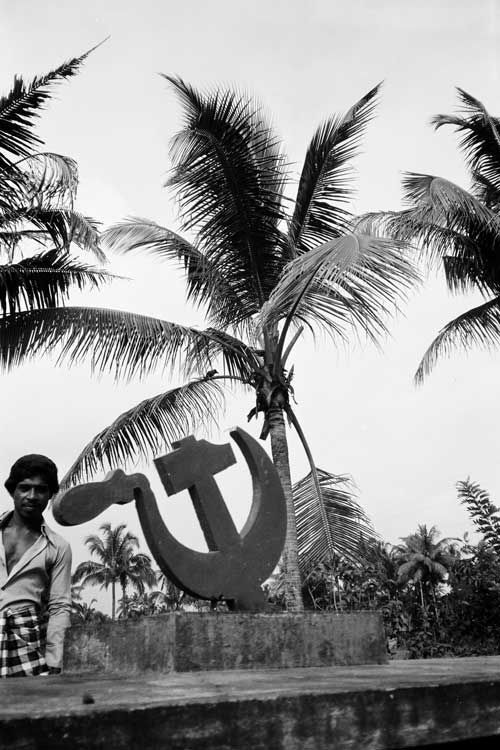
These two photographs, taken in Alappuzha in November 1983, show the Punnapra-Vayalar memorial site. In October 1946, coir workers, peasants, and fishermen organized under the Communist Party rose up against the aristocratic rule of Travancore Diwan, C. P. Ramaswami Iyer. Hundreds were killed when the state military violently suppressed the revolt. Together, these photographs reveal how political memory of an event that is marked by a lot of controversy is kept alive through statues and monuments. They also give us an insight into how public spaces are used by communities to make their histories visible.
Jeffrey on Statues and Monuments
Two aspects of statues seem important to me. The first is an examination of the first time a group or society proposes, or erects, a statue. Something in the community has almost certainly happened to provoke such an initiative. The second class of question relates to the controversy that surrounds the erection of—I suspect—most statues. One person’s hero may well be another’s villain.
From Robin Jeffrey, What the Statues Tell: The Politics of Choosing Symbols in Trivandrum (1980), p. 484
When it became necessary to win at least the passive approval of fairly large numbers of people for the actions of the state, it also became necessary to “project an image.” Statues were a way of exalting a ruler or a representative of a particular group, of bringing him constantly into the public eye and of thereby inducing people to regard him (or his devotees) as powerful, great and legitimate—people who should be supported, not overthrown.
From Robin Jeffrey, What the Statues Tell: The Politics of Choosing Symbols in Trivandrum (1980), p. 498
The Resident's Tomb
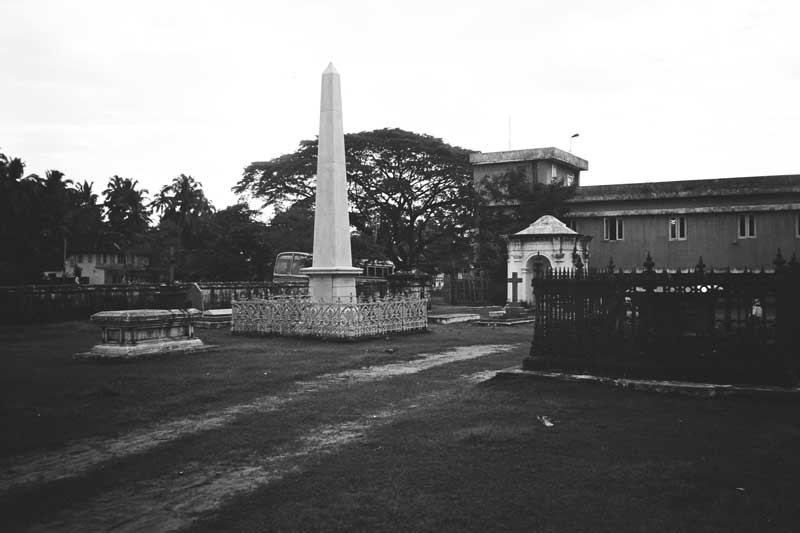
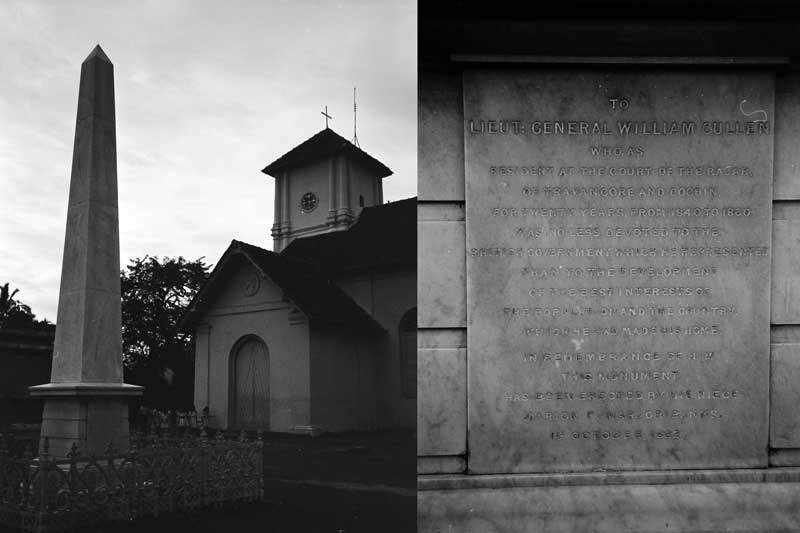
General William Cullen served as the British Resident in Travancore and Cochin from 1840 to 1860. He spent over two decades in the region and passed away in Alappuzha, where a road was named after him. Captured on 25 November 1983, this photograph depicts an obelisk and tombstone in his name. It remained long after the end of the British empire’s presence in India, even when colonial symbols were being questioned or removed. The photographs are an insight into what statues, whether they are kept or destroyed, say about the society in which they exist.
Jeffrey on Statues and Monuments
The context in which a statue is erected or removed is crucial, and the debates involved can tell us a good deal about the society concerned. For whom is the new statue intended as a symbol? Whom did the “disgraced” statue antagonize? What shifts in political power have occurred? What divisions are revealed within the statue-raising (or removing) public?
From Robin Jeffrey, What the Statues Tell: The Politics of Choosing Symbols in Trivandrum (1980), p. 502
Striking Workers
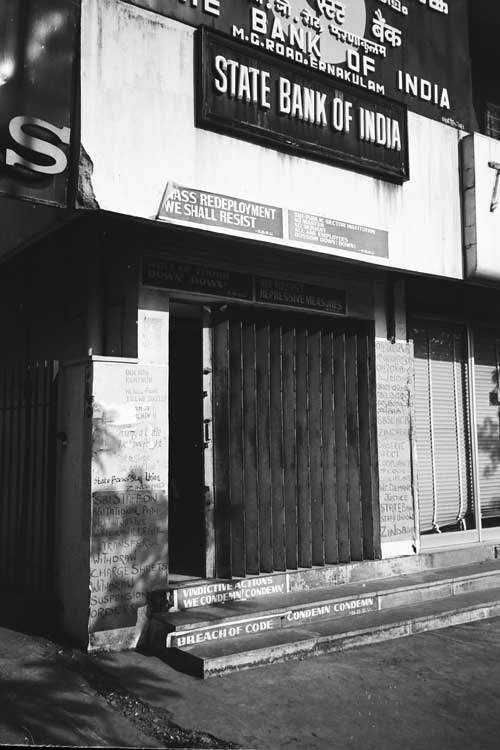
This photograph of the M.G. Road Branch of the State Bank of India in Ernakulam, taken on 26 November 1983, shows the entrance of the building completely shuttered, with its walls covered in banners and slogans.
By the mid-1980s, India’s trade union movement had to confront a government shift towards more market-friendly policies, creating tension between workers and the management. Kerala had one of the most organised labour movements in India, built across decades through the Communist Party. By the time Jeffrey took this photograph, this reputation was becoming contested.
Jeffrey on Kerala's Strikes
Some studies insist that by the 1980s the image of the militant Malayali worker was false. They argue that Kerala workers now lost no more days through strikes and disruption than workers elsewhere in India and that Kerala labour was at least as productive. Yet perceptions persist. Cochin Port, wrote India’s leading business magazine in 1987, ‘is saddled with high labour costs and low productivity’. Not a single major private business had invested in Kerala for ten years, India’s largest news magazine told readers in 1990. The CPI(M)-Ied government elected in 1987 felt obliged to deny a quality it might once have glorified. Its labour commissioner proclaimed that ‘there’s no labour militancy here any longer… Kerala labour will never again be militant. That phase is over’. There was now, he asserted, no clamour in Kerala.
From Robin Jeffrey, Politics, Women and Well-Being (1992), p. 220
Life Around the Coconut
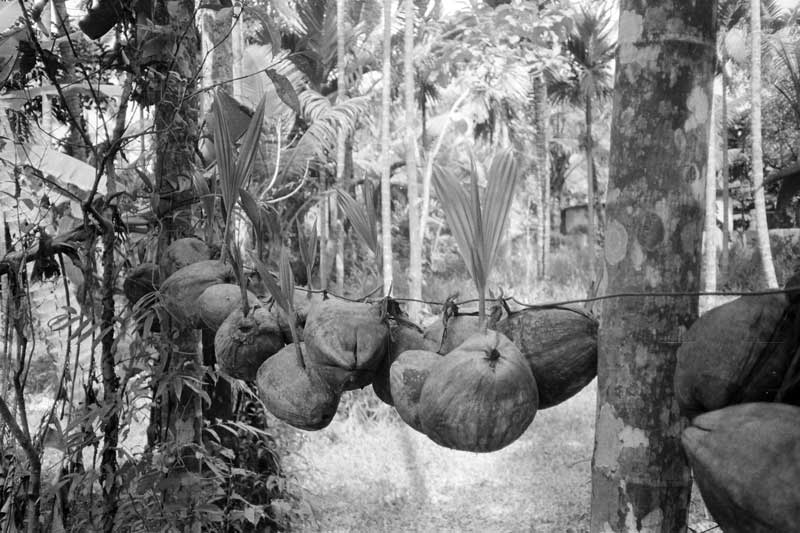
Taken on 27 November 1983 at Uchilikkal House between Ernakulam and Tripunithura, this photograph shows sprouting coconuts hung on a wire in the compound of the house, surrounded by other trees and plants. At the time, coconut covered around 25% of Kerala’s cultivated area and contributed to around 30% of the state’s agricultural income. Even the name of the state — “Keralam” in Malayalam — is derived from coconut: “Kera” meaning coconut and “Alam” meaning land. A simple photograph of what is perhaps a domestic chore is a portrait of an entire world of labour. Jeffrey’s own research has extensively documented how the crop is an integral part of the social order in Kerala.
Jeffrey on Coconuts
‘All but the poorest of Malabar ryots [peasants]’, wrote the Collector of Malabar, ‘have their own compounds of fruit trees’. Coconut was the most important. Organisers of a campaign to protect Kerala coconuts from Ceylon imports claimed in the 1930s that close to two-thirds of Malayalis depended on the coconut for survival. Even the landless relied on it. Landowners often gave the care of their coconut land to landless families who were permitted to put up a small hut amidst the trees and were given the produce of one tree in return for watering, manuring and harvesting.
…
The increase in coconut cultivation helps to measure the spread of Kerala’s cash economy. From the late nineteenth century, people increasingly recognised that more profit for less work was to be had from coconut than from paddy. By 1916, as the First World War made shipping scarce and paddy imports from Burma more difficult, officials detected a crisis. In Travancore, the government prohibited tenants on the Maharaja’s personal lands from converting paddy into coconut gardens. In Malabar and Cochin, conditions were similar. ‘The conversion of wet lands into [coconut] gardens along the coast… is going on steadily’, wrote officials in Malabar in 1915. ‘Year after year’, recorded the Dewan of Cochin in 1919, ‘land under rice is being converted into cocoanut plantations’.
…
The cultivation of the coconut palm spun a web around all levels of Kerala society. Landowners liked it because it grew easily and required less regular labour than most crops. The landless—very often Ezhavas, whose ‘traditional occupation’ was held to be the care of the palm—lived among the trees, harvested the nuts and prepared the products of the tree for sale. Other landless people, paid a tiny wage, soaked the outer husks in the backwaters to extract the coir fibre; some spun the fibre into rough yarn. Other poor people split the inner kernels and arranged the open halves in the sun to dry into copra. Middlemen organised great boatloads of husks, fibre or yarn for transportation along the backwaters to Alleppey where the coir industry nourished. Other middlemen specialised in transporting copra to the ports for export to crushing mills or to the few mills located in Alleppey and Ernakulam.
From Robin Jeffrey, Politics, Women and Well-Being (1992), p. 73-75
The Rubber Economy
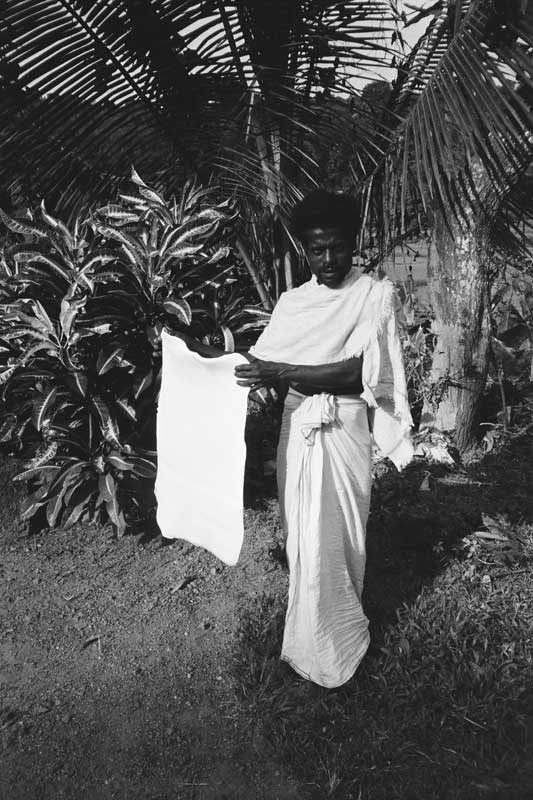
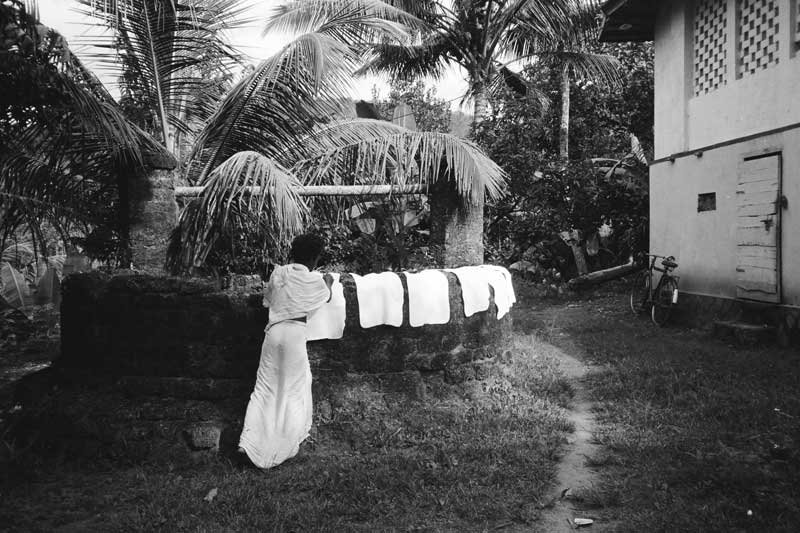
These photographs, taken on 4 December 1983 at the house of Abraham M. Nidhiry in Kuravilangad, show a man holding a freshly processed sheet of rubber and rubber sheets laid out to dry on the rim of a well. Kuravilangad, a town in the Kottayam district of Kerala, is an active part of Kerala’s rubber belt. Rubber cultivation in Kerala began in the colonial period and gradually replaced other crops in many parts of the state. Today, Kerala produces the most rubber in India and Kottayam—dubbed “the Land of Latex”—produces the most rubber in Kerala. These photographs capture the labour behind a commodity that carried a lot of weight in Kerala’s imagination due to its symbiotic relationship with wealth.
Jeffrey on Rubber
Rubber, however, provided the most dramatic example of a crop that made fortunes for some—and made others conscious of such fortunes. Rubber also exemplified the links between Kerala’s crops and economies far away. In 1904, the sale of motor cars in the USA doubled to 22000. In the same year, the Forest Department in Travancore demonstrated to its own satisfaction that rubber grew well in parts of the state. By 1912, when a fall in international prices led the passion for rubber to abate, Cochin had close to 3000 acres and Travancore more than 10000 in rubber. After the First World War, the keen hopes for a boom collapsed in 1921, ‘the most disastrous [year] in the history of the plantation rubber industry’, when the Americans stopped buying rubber. The depression drove prices down still further. In 1903 a pound of rubber had been worth 12 shillings in London; in 1931 it was worth little more than twopence. By the early 1930s, the 96000 acres of rubber in Travancore produced exports valued, in the worst year, at only Rs. 400000—about four rupees an acre.
The wartime transformation was breathtaking. The Japanese conquest of Malaya in February 1942 cut off one of the great sources of natural rubber, a vital commodity for war production. By 1945, Travancore’s rubber exports were worth more than Rs. 300 million, an increase of 750 times on their lowest value during the depression, though the area under rubber remained about the same at 100000 acres. No wonder rubber acquired a mythical, almost magical quality in modern Kerala.
The benefits of the wartime boom did not go solely to a minute class of great estate-owners. At least a third of the holdings of rubber in Travancore at the end of the war were of less than 10 acres and involved 23000 individual units. Though large holders were estimated to control 80 per cent of production, even they were usually Malayalis: the European interest in rubber planting had faded after the setbacks of 1921 and the depression. At the end of the war, perhaps 20000 families held rubber land in Travancore and Cochin, and they were intent on translating their wealth into respect and power.
To own a rubber estate became a shorthand description of the newly wealthy. In E. M. Kovoor’s novel, Katu (forest), published in 1964, the villain is a self-made man who began life as a labourer on a rubber estate. He becomes a major estate owner, a cheat, a puller of political strings. He is only saved from perdition by his good, Gandhian, youngest son, who demonstrates that ‘absolute honesty and love of fellow-beings are not impracticable ideals for men engaged in industry and trade’. The assumption of the novel, however, is that readers will readily accept that a self-made rubber-estate owner will require a lot of redeeming.
From Robin Jeffrey, Politics, Women and Well-Being (1992), p. 80-81
Kerala's Gulf Dreams
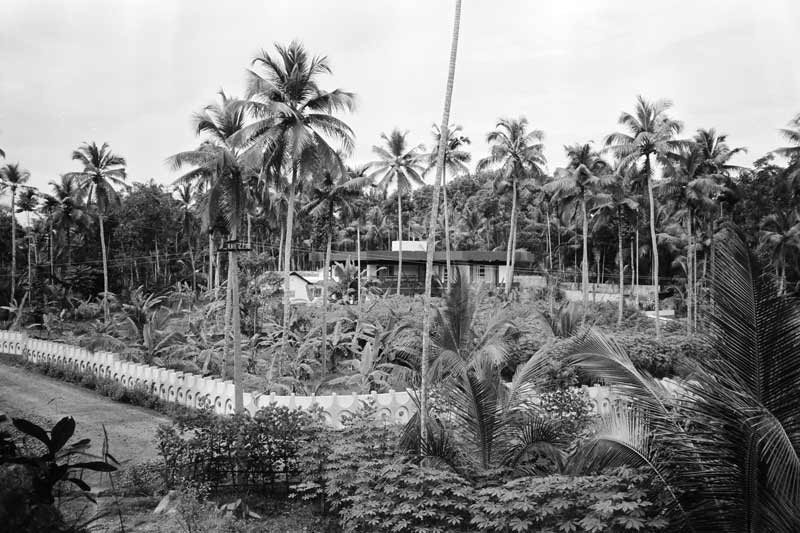
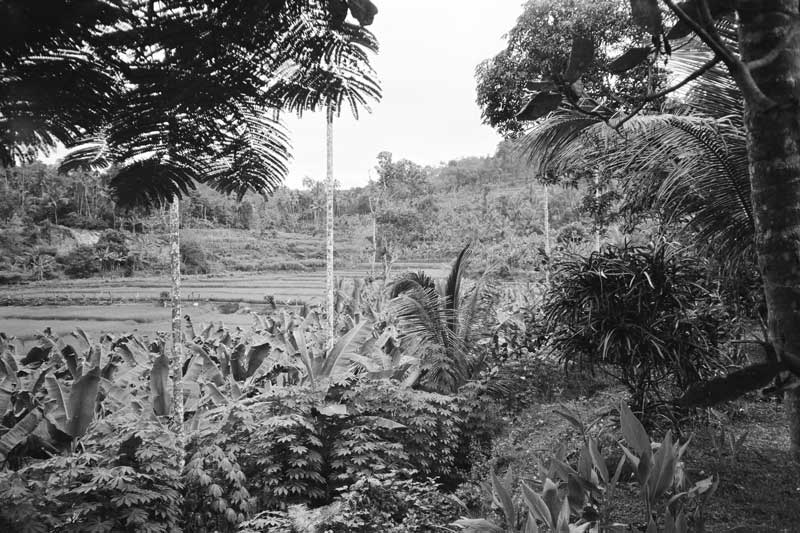
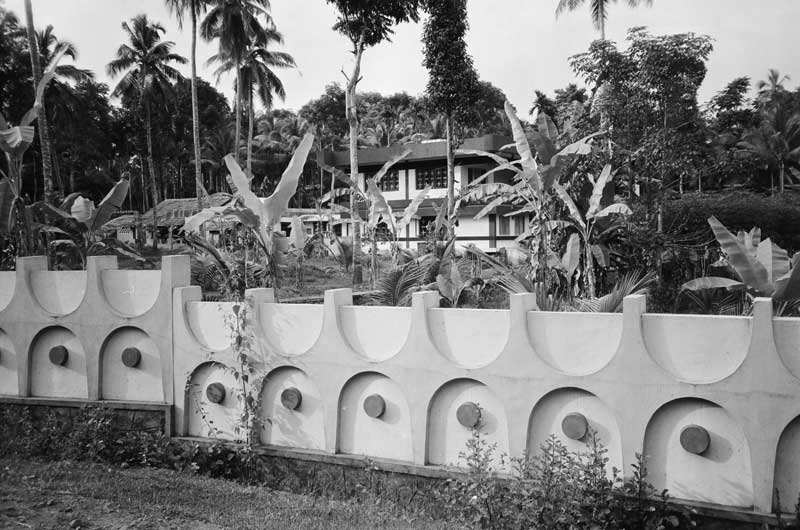
These three photographs, taken in Kuravilangad on 4 December 1983, show an environment in the process of change. In the late 1970s and early 1980s, migration to the Gulf was transforming Kerala in a visible way. Older houses were being replaced by concrete homes, as families invested their savings into buildings and land for the first time. These elaborate new homes often mimicked the aesthetics of Gulf cities, altering the nature of Kerala’s architecture. Beyond those who had received remittances, these so-called “Gulf houses” also influenced the broader population, who borrowed money to imitate this new style.
Jeffrey on Gulf Money
In the I970s, the readiness of Keralans to go anywhere and do almost anything, notable since the time of the First World War, found an outlet in the vast demand for labour in the oil-rich countries of West Asia or the Gulf. In the years after 1973, hundreds of thousands of Keralans working in West Asia have sent home foreign exchange which they have often used to buy land or build houses. The ‘Gulf boom’ has in a sense provided the hope that politics held out in the 1940s and I950s.
From Robin Jeffrey, Politics, Women and Well-Being (1992), p. 12
In old Kerala, particular styles of housing were the right of only some castes or religions, and the decline of these proscriptions simultaneously allows us to measure old Kerala’s collapse. The importance of house design for establishing a family’s position in its locality has led in the 1970s and 1980s to workers who prosper in the Gulf frequently using their earnings to build large, brightly painted concrete houses, strikingly different from the architecture of old Kerala.
From Robin Jeffrey, Politics, Women and Well-Being (1992), p. 204
Remittances of money from workers in the Gulf have been blamed for inflating the price of land and labour in Kerala and for spreading a variety of undesirable practices ranging from dowry to cigarette smoking. Mental illness among young wives left to live with in-laws is said to have increased. The large sums of money that workers in the Gulf send back to Kerala—rising at one stage to an estimated 28 per cent of the state’s income—are thought to go into unproductive expenditure on land, houses, jewellery and cars.
From Robin Jeffrey, Politics, Women and Well-Being (1992), p. 217-218
Public Spaces
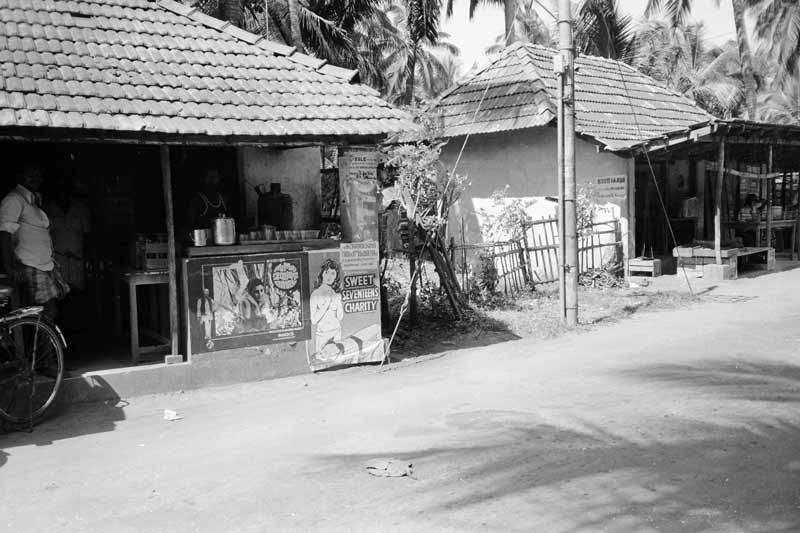
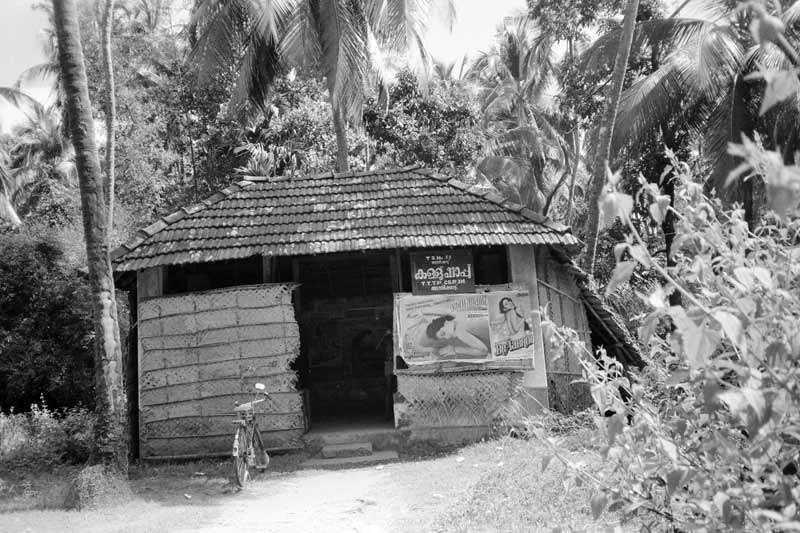
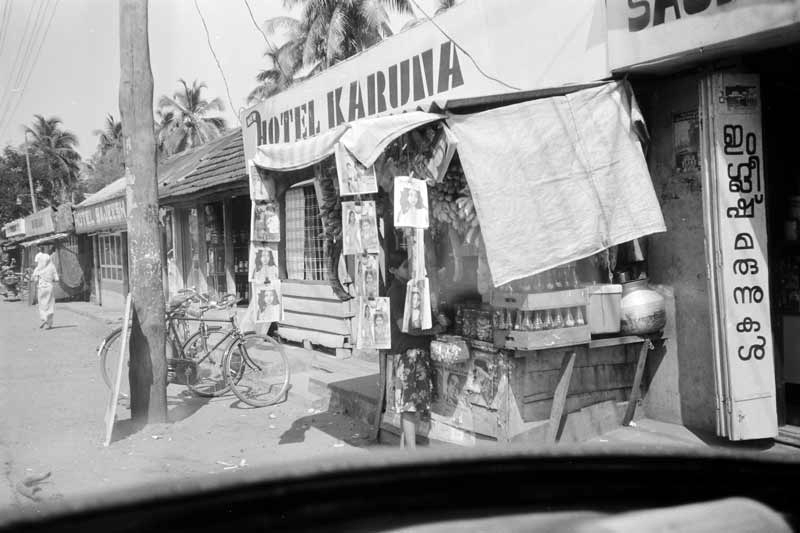
These three photographs, taken in November 1983 across Anthikad and Kollam, show small roadside establishments that formed part of everyday life in Kerala. Access to public spaces like these was pivotal in subverting the caste-based social order, which, for centuries, had excluded individuals from lower castes from shared spaces entirely. Early communists were quick to recognise the political potential of these secular spaces, using them as places to spread ideas of equality and engage communities across caste and class lines. Reading was, for most Malayalis, a collective act. Newspapers were discussed and argued over in public, making tea shops and other public spaces like it as much about the circulation of ideas and knowledge as about food or drinks. With these photographs, Jeffrey captures a portrait of public life in Kerala.
Jeffrey on Tea Shops
In old Kerala, the temples and houses of the high castes had been jealousy exclusive. The tea-shop, on the other hand, was noisily promiscuous. Tea-shops ‘served’, Mayer wrote, ‘as centres for inter-caste mixing, and have played a part in the weakening of caste restrictions’. People read the newspapers aloud and discussed the contents, and he, like the investigator in Cochin fifteen years before, was surprised to encounter two youths who spent a quarter of their income on tea.
Images of tea-shop behaviour became stereotyped. ‘As if chatting in a tea shop’, used as a contemptuous dismissal of a person’s regard for facts, was judged an unparliamentary expression when hurled by one Malayali at another in 1959, though ‘black lies’, used in the same exchange, was not. When the veteran journalist D. R. Mankekar visited Kerala in 1965, he elevated the tea-shop—he called them ‘coffee houses’—to ‘an institution where public opinion… is moulded…, the focal point… of the village’. Every tea-shop, ‘however humble in appearance, subscribes to half a dozen newspapers’. A popular story among Malayalis contends that if you climb Mount Everest, you will find a tea-shop at the top with two Malayalis in it. The customer will be reading a newspaper and arguing with the owner about politics.
There is more to this than simply random impression and good-humoured exaggeration. The 1971 census found that Kerala had four times more teashops per head of population than any other state in India—such establishments for every 1000 people. To give the figure perspective, it is worth pointing out that Kerala’s literacy rate in 1971 was only twice the national average.
Literacy also has a place in ‘tea-shop culture’ and the Kerala model. In 1984, Mangalam, a modest-looking weekly from Kottayam, specialising in sentimental fiction and lurid news, was the largest selling publication in India with a circulation just under a million copies a week. It surpassed the older, more staid Malayala Manorama Weekly, also of Kottayam, by 300000 copies. Costing Rs. 1.20, roughly the price of a cup of coffee and only 30 paise more than a daily newspaper, Mangalam has revealingly Keralan concerns. An issue in 1990, for example, had as one of its serials a story called ‘Vasundhara Medikkals’, the sad, romantic and long tale (this was Part 34) of the owner of—what else?—a pharmacy. The magazine’s charity promotion was to raise money for a cancer ward for the Kottayam Medical College Hospital. Mangalam demonstrated that the people’s health was a popular concern.
From Robin Jeffrey, Politics, Women and Well-Being (1992), p. 210
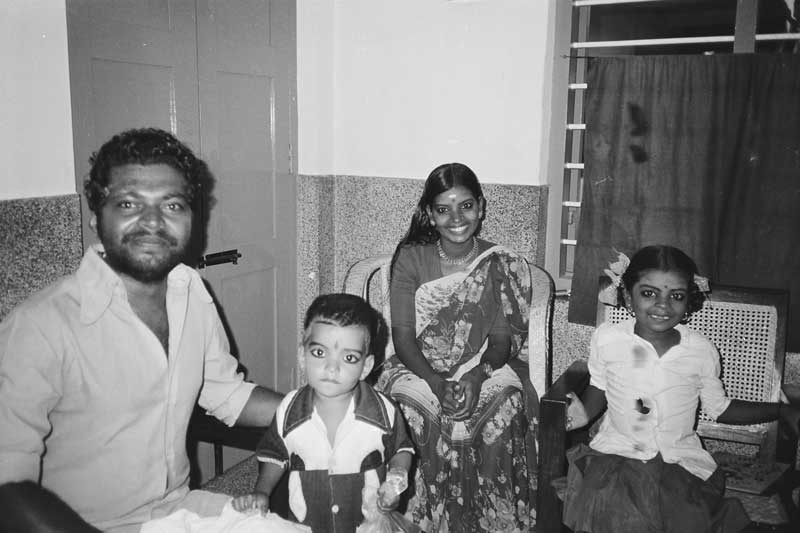
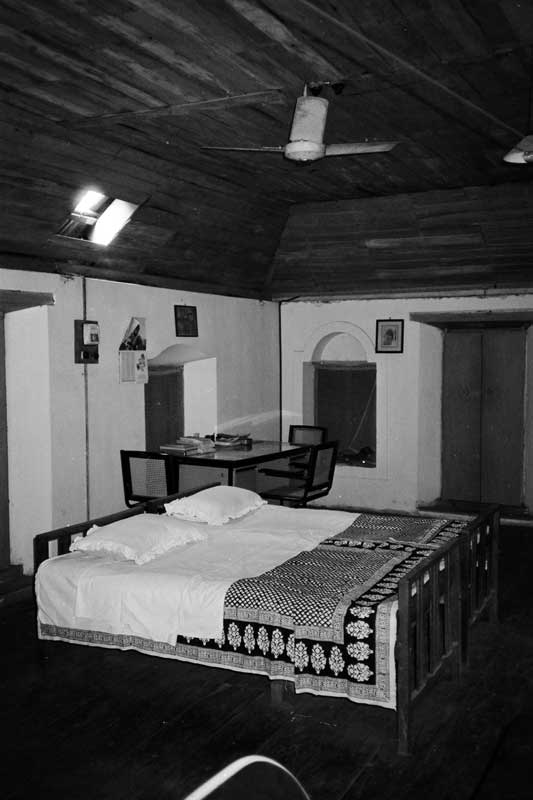
The Home in a New Kerala
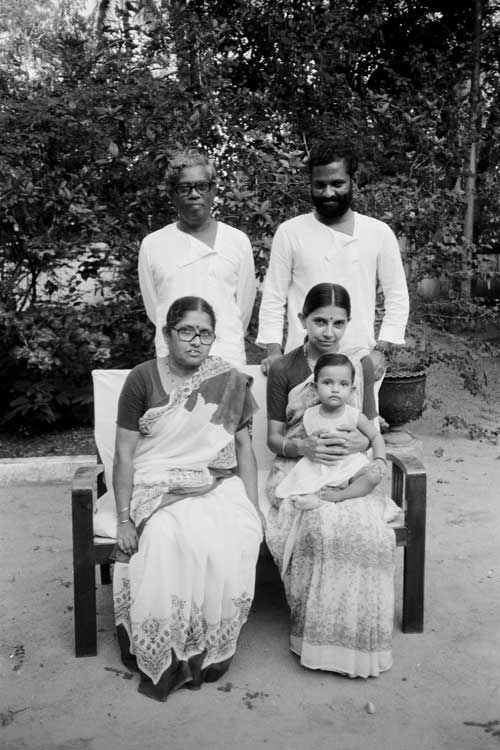
These photographs, taken across Thiruvananthapuram and Kuravilangad in 1983, paint a portrait of what a home looked like in a changing Kerala. For the longest time, the home was organised around the matrilineal joint household—the tharavad—in many communities. The house itself was therefore designed to accommodate the large family. In post-independence Kerala, that world had largely undergone a change. Jeffrey captures the new home that replaced the old one—one that was smaller and more private to adapt to the changing family structure.
Jeffrey on Family
The changes in ideas about, and practices within, families in Kerala provide a way of judging the extent of more general changes in attitudes. If attitudes towards the family have changed dramatically, it may be reasonable to infer that other attitudes—about what constitutes fitting political behaviour, for example—will have changed as well.
By the 1950s, politicians, officials and most Malayalis had arrived at similar ideas about what constituted ‘a family’. Indeed, the Communist government’s birth-control campaign in 1957 was called a ‘family planning program’. Documents about ‘family planning’ refer to ‘couples protected’. In 1961-2, when Puthenkalam surveyed 400 Nayar families throughout Kerala, he found less than a quarter were still based in the mother’s house , and most of these (58 per cent) were concentrated in central Kerala, in the drowsy, decaying grandeur of old Cochin. Only three per cent of marriages were now arranged by a mother’s brother—the potential karanavan in the matrilineal joint-family. And only 17 per cent of the families admitted to knowing of cases where a husband only visited, and did not live with, his wife. Such men, Puthenkalam concluded, were ‘of the old generation. One can predict that they will be the last of their class’. More than 70 per cent of families now lived in a house maintained—in theory, at least—by the father. The ‘model family’ of mother, father and not-too-many children was becoming increasingly widely shared.
From Robin Jeffrey, Politics, Women and Well-Being (1992), p. 53
This exhibition is part of Travelling Through Kerala With a Camera in 1983: Photographs by Author and Kerala Scholar Robin Jeffrey, on view at Kerala Museum from June to August 2026.
Browse the Janal Archive to view the full collection of photographs donated by Robin Jeffrey to Kerala Museum.
You can also watch Robin Jeffrey’s lectures from the Janal Talks series on YouTube.
Enjoyed this exhibition? Here are a few links below for you to read more!
Hadiya, Gaya. “Brewing Exclusion: Tea Shops and Women in Kerala.” Ala / അല, June 29, 2022.
Janal Exhibitions. “History of Women’s Education in Colonial Era.” The Kerala Museum, July 24, 2024.
Janal Exhibitions. “Reading Colonial Malayalam Women’s Magazine.” The Kerala Museum, December 4, 2024.
Jeffrey, Robin. “India’s Working Class Revolt: Punnapra-Vayalar and the Communist ‘Conspiracy’ of 1946.” The Indian Economic & Social History Review 18, no. 2 (April 1981): 97–122.
Jeffrey, Robin. Politics, Women and Well-Being. Palgrave Macmillan, 1992.
Jeffrey, Robin. “What the Statues Tell: The Politics of Choosing Symbols in Trivandrum.” Pacific Affairs 53, no. 3 (1980): 484–502.
Kerala Museum. “Dr. Mohamed Shafeeq Karinkurayil: The Affiliations of Malayali Migrant Photographs.” YouTube, August 26, 2023.
Kerala Museum. “Janal Talks #48 Old Kerala Homes: Through a Visitors Lens 1983 by Robin Jeffrey.” YouTube, September 17, 2025.
Kerala Museum. “Janal Talks #49 Shifting Worlds: Storying Objects from Kerala by Robin Jeffrey.” YouTube, September 18, 2025.
Kerala Museum. “Revisiting the Kerala Model: Politics, Women and Well-Being Thirty Years on by N S Madhavan.” YouTube, November 22, 2025.
Nair, Arya. “Thomas Oommen: Modernity in Post-Independent Kerala.” Scale, April 7, 2026.
P. C, Saidalavi. “Interview with Robin Jeffrey – Part I.” Ala / അല, November 30, 2019.
P. C, Saidalavi. “Interview with Robin Jeffrey – Part II.” Ala / അല, December 31, 2019.
S., Harikrishnan. “A Healthy Brew: Public Spaces and Deliberation in Kerala.” Ala / അല, December 31, 2019.
V Shoba. “Going Coconuts.” Open Magazine, December 26, 2019.
Films to Watch


